Financial crime compliance has a gap that detection tools cannot close. Regulatory enforcement actions consistently cite the same deficiencies: inadequate investigation documentation, incomplete beneficial ownership analysis, EDD files that didn’t go deep enough, SAR narratives that couldn’t explain how a conclusion was reached. The problem is not upstream. It is in the investigation layer between the alert and the examiner-ready case file.
L2/L3 investigations are still almost entirely manual. Alert volumes grow faster than investigation capacity. Institutional knowledge walks out with every experienced analyst who leaves. Documentation gets compressed under time pressure into case notes that don’t survive examiner scrutiny. Meanwhile, financial crime networks (sanctions evasion, money laundering, terror financing) operate through layered structures that entity-level investigations never reach.
The solution is autonomous investigation infrastructure: systems that perform the research, capture the reasoning, and deliver examiner-ready cases at scale. That is what closes the gap.
Detection Is Not the Problem
The compliance industry has spent years and significant resources improving detection. Transaction monitoring has grown more sophisticated. Sanctions screening now applies fuzzy matching, entity disambiguation, and automated ownership calculations. Behavioral analytics can flag typologies that would have required weeks of manual pattern recognition a decade ago.
Regulatory findings keep pointing to the same failure. Not detection. Investigation.
When enforcement actions land, the cited deficiencies are almost never “the screening tool missed the name.” They are inadequate investigation documentation. Incomplete beneficial ownership analysis. EDD files that didn’t go deep enough. SAR narratives that described what happened but couldn’t explain why the institution reached its conclusion. The gap is not upstream. It is in what happens after the alert escalates.
This is the second article in a series examining financial crime investigation as a compliance discipline. The first introduced the investigation layer as a category. This piece goes deeper into why the gap persists and what it costs when it does.
The Investigation Gap: What It Is and Why It Persists
L2 and L3 investigations are where financial crime compliance actually happens. The alert is a signal. The investigation is the work. And that work (hypothesis formation, multi-source evidence gathering, cross-jurisdictional entity tracing, documented reasoning) does not scale the way alert generation does.
Capacity Cannot Keep Pace
Complex L2/L3 investigations take hours to days each; cross-border beneficial ownership cases longer still. Alert queues grow faster than any team can absorb them at that pace. The investigation analyst capacity shortage isn’t a staffing oversight. It is a structural condition. You cannot hire your way out of a backlog whose inputs compound faster than your capacity to process them.
The structural nature of this problem is worth sitting with. Compliance budgets have grown substantially over the past decade. Headcount has grown alongside them. And yet the backlog problem persists at most major institutions, because the fundamental rate mismatch between alert generation and investigation resolution hasn’t changed. Adding analysts shifts the constraint; it doesn’t remove it.
Investigation Quality Is Not Consistent
Depth is the second problem, and it runs alongside capacity. Investigation quality is not consistent across a team. A senior analyst with five years of financial crime experience brings pattern recognition to a case that a junior analyst running the same workflow cannot replicate. The senior analyst knows which adverse media sources carry weight in a given jurisdiction. They understand how to interpret a nominee director arrangement in Cyprus differently from one in the UK. They recognize that a beneficial ownership chain that looks clean in Companies House might resolve differently when cross-referenced against Bureau van Dijk.
That knowledge is not documented anywhere. It lives in the analyst’s head, and when the analyst leaves, which they do at rates compliance departments find difficult to manage, investigation quality drops until someone else accumulates the same experience.
Institutional Knowledge Walks Out the Door
This is the tribal knowledge problem. It is well understood by compliance leaders and almost never solved. There is no system that captures how experienced investigators form hypotheses, which data sources they weight, or how they connect signals that appear unrelated in isolation. Every departure is a knowledge loss. Every new hire is a months-long ramp. During that ramp, cases are weaker, and the institution has no way of knowing by how much.
The downstream consequences are real. Junior analysts learning by doing produce early casework that relies on incomplete pattern recognition. Regulatory findings on EDD quality are among the most common in compliance examinations, and the quality distribution within teams is a major contributor to that.
Documentation Is an Afterthought
The documentation problem sits underneath all of this. Investigations are rushed. When an analyst is managing a queue under time pressure, documentation gets compressed into case notes that summarize a conclusion rather than record a process.
“Reviewed adverse media, no findings” is not a source-traced evidence record. “Checked ownership structure, no sanctions exposure” is not an audit trail. These notations tell the examiner what the analyst concluded. They do not tell the examiner how the analyst got there, which sources they consulted, what the search parameters were, or what evidence they weighed before reaching a decision.
When the examiner asks “Walk me through your reasoning on this case,” the file has to speak for itself. At most institutions, it doesn’t. The analyst reconstructs a decision made months earlier from incomplete memory and an incomplete record. That reconstruction is not what regulators require. They require investigation reasoning documentation: the logic that led to the conclusion, captured at the time it was formed.

How the Bottleneck Manifests in Outcomes
The capacity and quality gaps compound into three categories of consequential failure.
Backlogs Become Regulatory Findings
Cases sit in queues. L2/L3 backlogs are not only operational problems. They are regulatory findings. Unresolved escalations represent unresolved risk exposure, and examiners treat them as evidence that a compliance program cannot process what it generates. Speed and thoroughness are made to feel like a trade-off because investigation doesn’t scale. When timelines compress under backlog pressure, depth is the first casualty. Examiners notice.
Investigations Stop at the Name, Not the Network
Point-in-time, entity-level investigations miss the structure that financial crime actually operates through. A single alert might flag a counterparty. The exposure sits in the beneficial owner two layers away, the family member routing payments through a registered company in the UAE, or the freight forwarder whose invoices don’t match commodity benchmarks. Investigations that stop at the name on the alert never reach the topology around it.
Iran’s sanctions evasion architecture illustrates this clearly. As documented by sanctions enforcement veterans and defense policy analysts, Chinese firms have openly marketed drone components (engines, gyroscopes, fiber-optic cables, navigation systems) to Iranian and Russian buyers, typically through small exporters that carry no U.S. correspondent banking relationships. Tehran’s procurement network doesn’t route through named entities. It routes through a supply chain of intermediaries who each appear unremarkable in isolation. Former senior OFAC officials have framed the resulting challenge precisely: the issue is not whether sanctions work. It is whether institutions can see the network well enough to know if they are hitting the right targets.
Screening catches the designated front entity. It does not map what sits behind it. Only investigation does that. And most investigation workflows are not built to think at the network level.
Case Files Don’t Survive Examiner Scrutiny
This is where the gap becomes a direct regulatory liability. External examiners reviewing a specific case or alert are looking for a defensible audit trail. Their primary concern is whether the analyst followed the firm’s written policies and applied sound logic, or simply cleared the alert to reduce the queue. The distinction matters enormously, and experienced examiners can tell the difference quickly.
Their review typically covers four areas. On investigation logic, they ask whether the closure rationale is clear and objective, whether the SAR narrative (if filed) answers who, what, when, where, and why, and whether the analyst reviewed the customer’s historical baseline or evaluated the transaction in a vacuum. On evidence, they check whether all supporting data is physically attached to the case file, whether any customer explanations were validated rather than accepted at face value, and whether the analyst checked all relevant internal systems including related accounts and ultimate beneficial owners. On timeliness, they verify whether the investigation was completed within statutory deadlines, whether escalation paths were followed correctly, and whether the case shows signs of being rushed during periods of high alert volume. On consistency, they ask whether two identical alerts would have received the same level of scrutiny and whether the analyst looked beyond the individual client to consider whether the alert pointed to a broader network.
Most investigation files fail on at least one of these dimensions. Not because the analyst made a wrong decision, but because the documentation doesn’t demonstrate how the right decision was reached. Examiner-ready case files are not a quality aspiration. They are a documentation standard. Source-traced evidence. Documented reasoning logic. An immutable audit trail that shows what was known, when it was known, and how it was acted on. “The model scored it low” is not a defensible answer. Neither is “the analyst reviewed it.”
Why Better Alerts and More Data Don’t Solve This
The instinct when compliance programs struggle is to invest upstream. Better detection. More data sources. Improved screening tools. These investments are not wrong, but they don’t address where the system breaks.
More Alerts Without More Investigation Capacity Makes It Worse
Detection has improved substantially. Transaction monitoring is more sophisticated than it was five years ago. Sanctions screening now applies fuzzy matching, cross-list coverage, and automated 50% ownership rule calculations. The problem is not that alerts are too inaccurate. Financial institutions already handle more alerts than they can adequately investigate. Adding higher-precision alert generation to an underresourced investigation function makes the backlog worse. A more accurate queue is still a queue.
Data Access Is Not the Constraint
Compliance teams already have simultaneous access to Dow Jones, World-Check, LexisNexis, Companies House, PACER, adverse media aggregators, dark web intelligence feeds, and multiple sanctions lists. The data exists. The bottleneck is synthesis. An investigator with access to twelve browser tabs and six hours still has to connect the evidence, reason over it, document the logic, cite the sources, and write a narrative that will hold under examiner scrutiny. Access to data is not the same as an investigation. Data doesn’t investigate itself.
Every Case Still Starts from Scratch
The investigation itself, the workflow of taking an alert and producing an examiner-ready, source-traced case file, is still almost entirely manual. Every escalation starts from scratch. The next analyst working a similar case does the same manual research, consults the same sources, and produces documentation of varying quality depending on their experience and the time available. The institutional knowledge from the previous case was never captured. It went into a closed file and is inaccessible for the next one.
How the Investigation Gap Enables Financial Crime Networks
This is where the capacity problem becomes a broader systemic failure, not just an operational one. Financial crime networks are adversarial systems. They probe for seams. They adapt to enforcement pressure. And the seam they consistently exploit is the gap between what screening identifies and what thorough investigation reveals.
Sanctions Evasion Operates Behind Layers Screening Cannot Reach
Iran’s procurement infrastructure is a well-documented example. The procurement model Tehran developed under maximum pressure has not collapsed under sanctions. It has adapted, scaled, and been exported. Russian procurement for the war in Ukraine draws from the same architecture. Hezbollah, the Houthis, and Iraqi Shia militias operate through the same layered financing structures.
For a financial institution, this means the exposure doesn’t sit in the named entity. It sits in the network around the named entity. A Chinese exporter of optical components may carry no sanctions designation and no adverse media in English. The relationship between that exporter and an Iranian procurement intermediary is not visible in a screening tool. It becomes visible only through a cross-border beneficial ownership investigation that traces the supply chain, identifies the counterparties, and maps the connections between them.
Compliance Officers Are the Enforcement Mechanism
Miad Mali, former head of global targeting at OFAC with oversight of approximately 125 investigators across more than 35 sanctions programs, described the mechanic directly at a recent sanctions compliance panel: “We put sanctions in place and we draft fancy press releases, but in reality the people who implement sanctions are the compliance officers in banks, the compliance officials in industry. These are the boots on the ground.”
SARs and investigation quality are what give enforcement agencies the corroborating intelligence they need to build designation cases. An institution that generates clean-looking case closures without adequate investigation isn’t only failing its own compliance obligations. It is degrading the intelligence pipeline that enforcement depends on.
The $150 million Hezbollah art case he described makes this concrete. OFAC served a blocking order on art held by a Hezbollah-linked individual in New York. The funds were there. The network was there. But the individual did not directly own or control the assets. They operated through intermediaries. Surfacing that structure required tracing a network, not running a name through a list. A compliance program that investigated the name and stopped there would have cleared that counterparty without flagging the exposure.
Money Laundering Networks Exploit the Same Blind Spot
Professional money laundering organizations service multiple criminal groups simultaneously, routing funds through layered shell structures designed to appear unremarkable at every node. Mule networks share identity signals across hundreds of accounts (the same address, device ID, email pattern, phone number) in ways that are invisible if you investigate accounts individually but obvious if you investigate the topology. A single investigation that stops at the flagged account misses the ring. The full exposure only becomes visible when the investigation is network-aware.
What Closing the Investigation Gap Actually Requires
The investigation capacity shortage is not a headcount problem. You cannot hire enough analysts to keep pace with alert volume growth while simultaneously improving investigation quality and maintaining institutional knowledge. Compliance programs that have attempted to solve it through staffing find that the bottleneck moves: they now have a training problem, a quality consistency problem, and a knowledge retention problem layered on top of a capacity problem.
Autonomous Investigation, Not Faster Analysts
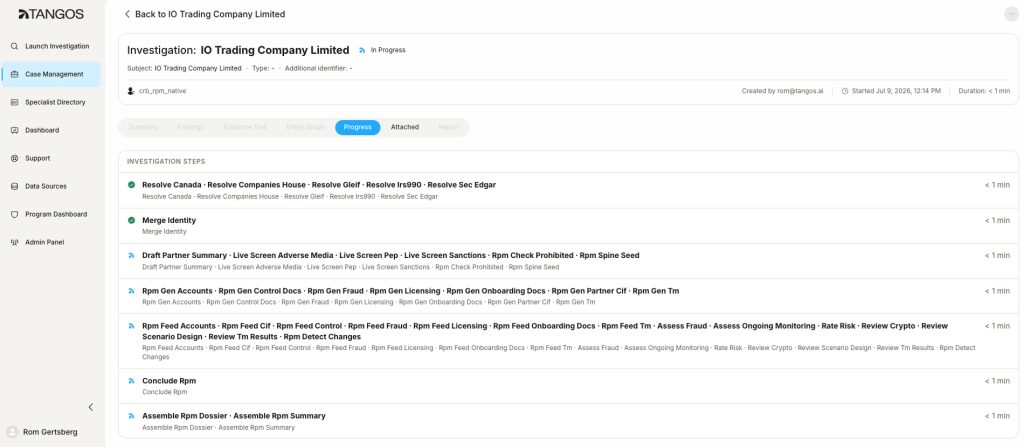
Closing the gap requires autonomous investigation infrastructure. A system that takes an escalated alert and performs the research (hypothesis formation, multi-source evidence gathering, cross-jurisdictional entity tracing, ownership analysis, adverse media assessment) and returns an examiner-ready case file. Not a draft for the analyst to finish. A complete investigation record, source-traced and audit-trailed, ready for review and sign-off.
This is a different category of solution from tools that make analysts faster. A faster analyst still has a fixed ceiling on investigation throughput. The investigation analyst capacity shortage is structural. Tools that optimize individual output don’t change the structural constraint. What changes it is investigation infrastructure that performs the work, rather than assisting a human performing it.
Captured Decision Intelligence
The knowledge that senior investigators carry (which sources to prioritize, how to interpret a nominee arrangement in a given jurisdiction, what adverse media signals indicate material risk versus background noise) needs to be encoded into the investigation process itself, not left in individual heads. Systems that capture this reasoning, not just the output, compound institutional knowledge rather than depleting it with every departure. Every case resolved becomes a reference for every subsequent case. The institution’s investigative capability accumulates rather than cycling back to baseline each time an experienced analyst leaves.
Examiner-Ready as the Default Output, Not a Rework Step
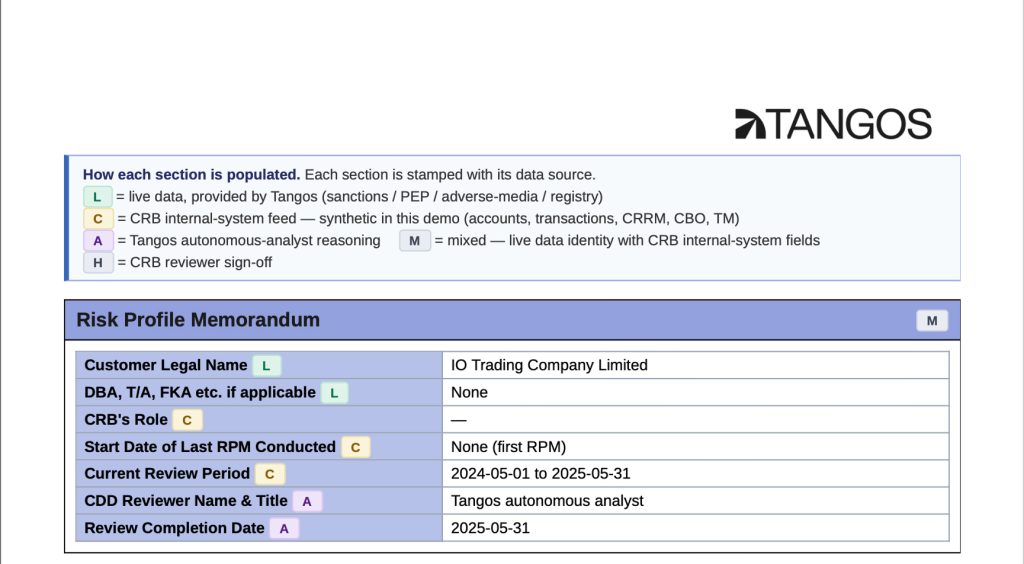
Every investigation should end with source-traced evidence for every claim, an immutable audit trail recording what was queried and what was found, and a narrative that documents the investigative logic from alert to conclusion. Not as preparation for an examination. As the standard output on every case. The investigation report is the audit artifact. It should survive examiner scrutiny on delivery, without a second analyst doing rework to clean it up beforehand.
The question that has to drive every financial crime investigation is no longer “Is this counterparty on a list?” It is “What network is this counterparty inside, and where in that network does our exposure sit?” That question requires network-aware investigation. Screening cannot answer it.
How Tangos Closes the Gap
Tangos AI’s Autonomous Intelligence Engine is built specifically for the investigation layer. It takes escalated alerts and resolves them end to end: forming hypotheses, querying data sources across jurisdictions and languages simultaneously, tracing ownership structures, assessing adverse media, and returning a complete, examiner-ready case file. Investigations are resolved, not drafted for an analyst to finish.
The analyst’s role shifts from executing research to reviewing conclusions, applying judgment where the case requires it, and signing off. That shift changes the structural constraint. Institutions scale investigation capacity without scaling headcount, and every case is resolved at consistent quality regardless of who reviews it.
Every investigation the Autonomous Intelligence Engine resolves also captures the reasoning behind it: which sources were queried, how ownership was traced, what the evidence showed, and why the conclusion holds. That reasoning accumulates as institutional knowledge. When experienced investigators leave, their decision logic stays. The output on every case includes a full evidence annexe with source citations, an immutable audit trail, and a narrative that documents the investigative logic from alert to conclusion. When the examiner asks “Walk me through your reasoning,” the file answers without the analyst having to reconstruct anything.
Why This Matters Now
Enforcement velocity is accelerating. Iran snapback sanctions have returned alongside existing OFAC SDN obligations. Russia export controls have expanded the scope of what institutions need to investigate. Beneficial ownership transparency mandates under FinCEN’s CDD rule and the EU’s incoming AMLA framework are raising the documentation depth that EDD files must demonstrate. Counter-terror finance scrutiny following October 2023 has intensified pressure on CTF programs across the industry.
The gap between how fast adversarial networks adapt and how fast institutions investigate is widening. Compliance programs that process alerts without producing thorough, network-aware, examiner-defensible investigations are not meeting their regulatory obligations regardless of alert volumes or false-positive rates.
Investigation is compliance’s last bottleneck. The tools that generate alerts have improved. The data infrastructure exists. What hasn’t changed is the investigation layer between the alert and the examiner-ready case file. Every major compliance enforcement action in the recent record makes the same point: investigation quality determines compliance outcomes.
Coming next in this series: a deeper look at each root cause: from the tribal knowledge problem to the documentation gap to why cross-border beneficial ownership investigations break down, and what it takes to solve each one.