The phrase gets used constantly in financial crime circles. Examiner-ready case files. Examiner-ready documentation. Examiner-ready output. It has become one of those compliance terms that sounds precise while meaning almost nothing in practice.
Here is what I’ve seen: most institutions believe their investigations are examiner-ready until an examiner reviews them.
The gap between performing an investigation and being able to prove you performed it well is where enforcement actions are born. Over the past 24 months, every major financial crime enforcement action traces back to the same root cause. Not detection failures. Investigation and documentation gaps.
That distinction matters. Detection has improved. Transaction monitoring has grown more sophisticated. Sanctions screening covers more lists across more jurisdictions than ever before. The technology for flagging suspicious behavior works. The problem is what happens after a case is escalated.
Manual investigation processes fail in predictable ways:
- Under volume pressure, documentation quality degrades before investigation quality does
- When experienced analysts leave, their reasoning leaves with them
- When the same investigator who runs the program tests its effectiveness, independence is gone
- When an examiner asks to see the reasoning behind a filing decision and the file cannot answer, the finding writes itself
This article defines what examiner-ready evidence actually requires. It focuses particularly on sanctions investigations, where the documentation standards are both the clearest and the most consequential.
The Three Non-Negotiables
Across the FFIEC BSA/AML Examination Manual, OFAC guidance, and public enforcement records, examiner-ready evidence resolves to three elements:
- Timestamp. Every piece of evidence must be dated to a specific activity, not a quarter, not an approximate period. A dated OFAC screening log showing hits reviewed and resolved is evidence. “We screen against OFAC” is an assertion.
- Attribution. Every action must identify who performed it. Independence gaps surface here. If the same analyst who ran the screening also documented the override, that independence gap will be flagged regardless of the underlying accuracy.
- Artifact. Every conclusion must be supported by documentation that can stand on its own. Examiners do not verify assertions. They verify artifacts.
The format of those artifacts matters as much as their existence. Retroactive documentation has signature characteristics: inconsistent formatting, levels of detail that don’t match the original workflow, references to events that postdate the alleged completion. Institutions that attempt retroactive assembly fare worse than institutions that document gaps honestly.
Timing is the underappreciated variable. Evidence captured at the moment compliance work is performed is naturally timestamped, attributed, and complete. Evidence reconstructed afterward is inherently compromised.
What Sanctions Examinations Actually Test
Sanctions investigations sit at the intersection of the most complex entity resolution problems in financial crime and the highest-stakes regulatory consequences. A true positive missed carries existential risk. An undocumented decision carries regulatory finding risk. Both demand the same thing: an investigation file that a regulator can read, follow, and defend.
For every screening hit, examiners want to see:
- The entity identification that triggered the alert
- The multi-list cross-reference that was performed
- The name-matching methodology that was applied
- The ownership analysis that established whether the OFAC 50% rule was relevant
- The conclusion reached on true positive versus false positive
- The documented reasoning that connects the evidence to that conclusion
A finding of “false positive” is not a decision. A finding of “false positive, confirmed by address correlation analysis and cross-reference against OFAC SDN, UN Consolidated, and EU lists, with no corporate ownership overlap identified through Companies House and BVI registry review” is a decision. The difference is the investigation behind it.
Sanctions investigations are particularly demanding because the adversarial behavior they address is deliberately designed to resist documentation. Sanctioned entities operate through intermediaries. Ownership structures are built across jurisdictions specifically to obscure beneficial control. A senior OFAC investigator can accumulate 5,000 sanctions actions over a career by understanding that the designation target often doesn’t own or control funds directly. Institutional compliance teams face the same problem with less intelligence access and fewer resources.
That is the investigation challenge. The documentation challenge sits on top of it.

The Specific Documentation Gaps That Generate Findings
Independent testing failures are the most common path from investigation weakness to regulatory finding. Examiners review independent testing not as a formality but as the primary signal of how seriously an institution’s leadership treats financial crime risk.
The most recurring weaknesses in sanctions examinations are not about screening coverage. They are about adjudication quality:
- Dispositions without reasoning. Hit-resolution documentation that records an outcome but not the evidence chain that produced it.
- Override memos that conclude without citing. The conclusion is stated. The analysis is absent.
- Independence failures. Investigation files where the same analyst who performed the screening also documented the outcome.
- Inconsistency across similar cases. Two files, similar fact patterns, materially different reasoning depth. The examiner’s question is not which conclusion was right. It is which process produced both.
Sampling discipline is a separate and frequently examined failure point. Examiners document how they selected their samples, and they expect institutions to have done the same. Testing without defined sampling methodology, consistent sample sizes, and documented selection rationale is not testing. It is review.
What This Looks Like in Practice
A mid-sized payment institution receives a sanctions screening alert. The screened entity is a corporate account with a name that generates a fuzzy match against an SDN-designated individual operating through front companies in three jurisdictions.
The analyst reviews the hit. She knows her institution well. She has seen this particular naming pattern before — a common transliteration that triggers matches across dozens of accounts with no real sanctions exposure. She closes the alert as a false positive. The override memo reads: “Name match only. No additional indicators. Closed.”
Eight months later, an examiner reviews a sample of sanctions adjudications from the prior year. The file lands in the sample.
The examiner has three questions. First: what methodology was applied to confirm this was a name match only? Second: was corporate ownership reviewed against the OFAC 50% rule? The designated individual was known to control entities through nominees. Third: would a different analyst reviewing the same file reach the same conclusion?
The answers, as documented, are: analyst judgment, no, and unknown.
The analyst’s conclusion may well have been correct. The institution may have had no actual sanctions exposure. None of that matters to the finding. What the examiner sees is a disposition with no evidence chain — a conclusion stated without proof of the investigation behind it.
The finding is not that the institution failed to screen. It is that the institution cannot demonstrate the quality of its adjudication process. That distinction drives the consent order.
The senior analyst who processed hundreds of similar files over three years left the institution four months before the exam. Her methodology, her pattern recognition, the reasoning she applied consistently across those cases — gone with her. What remained in the system was the output of her judgment, without the judgment itself.
Why the Investigation Layer Hasn’t Caught Up
Detection tools generate consistent, documented outputs by design. An alert is a structured artifact with a timestamp, a rule trigger, a risk score, and an entity identifier. It is examiner-ready before an analyst touches it.
The investigation is not. By the time a case file reaches disposition, it has passed through multiple analysts, drawn on external data sources, required judgment calls on entity disambiguation, and produced a conclusion that represents the investigator’s synthesis of everything gathered. That synthesis is what the examiner will scrutinize, and in manual environments it is what most commonly fails.
The institutional knowledge problem compounds this. A senior investigator conducting sanctions work carries methodology, judgment, and pattern recognition that is not captured in any case file. When that investigator leaves, their expertise leaves with them. The cases they closed remain in the system. The reasoning behind them is gone. Institutional knowledge that doesn’t compound creates examination exposure every time it walks out the door.
Analyst turnover is not a human resources issue. In investigations, it is an evidence quality issue.
What Examiner-Ready Actually Requires
An examiner-ready investigation file, in the sanctions context, needs five things:
- A documented hypothesis at the start. What was the investigation testing? What triggered it? What were the competing explanations for the alert?
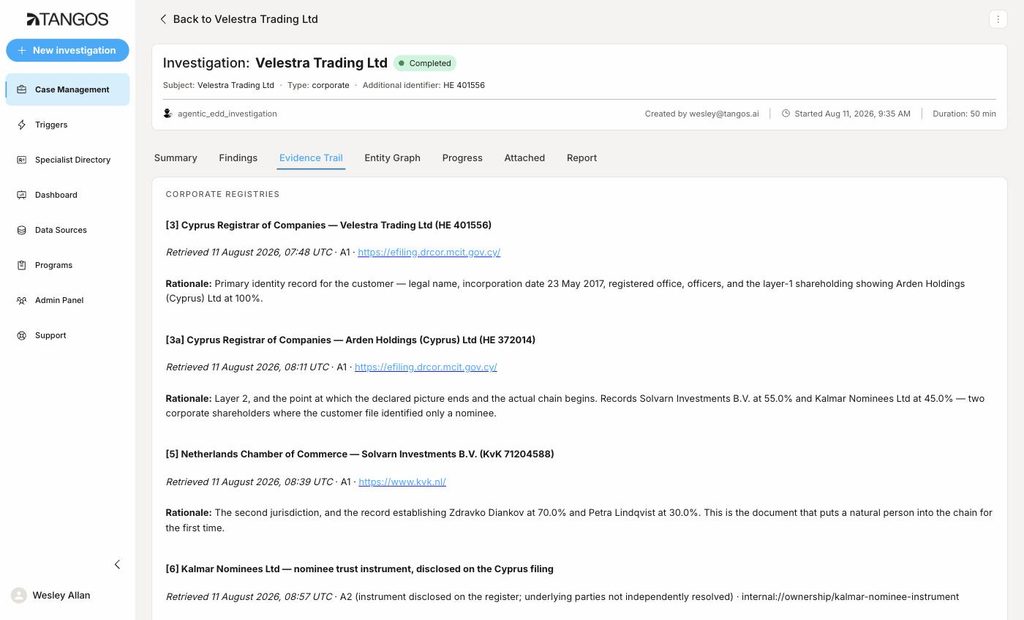
- Source-traced evidence for every finding. Not “ownership analysis indicated no 50% threshold breach” but a documented ownership trace citing the registries queried, the ownership percentages identified at each layer, and the calculation that produced the conclusion.
- A complete methodology record. Which lists were checked? In what sequence? What fuzzy-matching logic was applied? What thresholds governed the disambiguation?
- An independent evidence path. The investigation should be reproducible from the file. A reviewer who wasn’t in the room should be able to follow the reasoning to the same conclusion.
- An immutable audit trail. Timestamps that reflect real-time activity. Attribution that identifies every contributor and their role. Version history that shows how the file evolved from first review to final disposition.
These five requirements are not bureaucratic additions to the investigation. They are the investigation, documented in the form that proves it happened.
How Tangos Closes the Gap Autonomously
Tangos is the Autonomous Intelligence Engine for financial crime investigation. Every case that enters the engine exits as a complete, examiner-ready file. The output isn’t a draft that an analyst rewrites. It is a closed investigation with source-traced evidence, a documented reasoning chain, and an immutable audit trail.
For sanctions specifically, the engine deploys its Sanctions Screening Specialist against every hit. The investigation delivers:
- Multi-list disambiguation across OFAC SDN, UN Consolidated, EU, HM Treasury, FinCEN 314(a), and Interpol Red Notices, run simultaneously
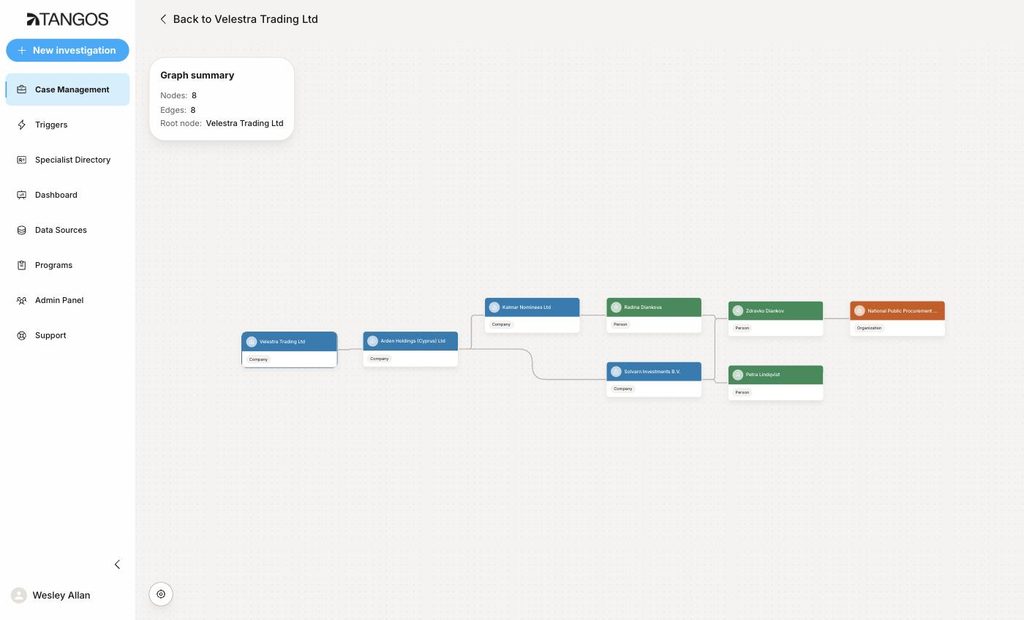
- OFAC 50% rule calculation applied automatically where corporate ownership structures are present, with the trace documented layer by layer through global corporate registries
- An adjudication memo as output: true match or false positive, with every data point cited, every registry queried listed, and every reasoning step recorded
Investigation Playbook SDN-SCR-003 governs this process. The playbook is versioned, auditable, and configurable. When an examiner asks why a particular adjudication was reached, the answer is in the file, not in the memory of whoever last touched the case.
The same principle applies across AML, EDD, KYC, and beneficial ownership investigations. Investigations are resolved end to end, with the reasoning quality of a senior investigator and the documentation discipline that examiners require.
This is what captured decision intelligence means in practice. The institutional knowledge that a senior investigator accumulates over years of sanctions work is encoded into every case the engine resolves. It doesn’t leave when the investigator does. It doesn’t degrade under volume pressure. It doesn’t vary based on which analyst happened to pick up the file.
Investigators shift from data collection to judgment. They review, challenge, and apply the contextual knowledge that no system can replicate. The investigation itself arrives ready.
The Standard Is Already Set
Examiners are not asking for something new. They are asking for what has always been required: documented reasoning, source-cited evidence, consistent methodology, and an investigation file that answers every question without follow-up.
The gap has never been in the standard. It is in the investigation process. Manual investigations under volume pressure produce inconsistent documentation. Inconsistent documentation fails examination. And examination failure, in the sanctions context, carries consequences that no institution can absorb as routine.
The standard is already set. The question is whether the investigation infrastructure can meet it, every time, at the pace that financial crime actually moves.